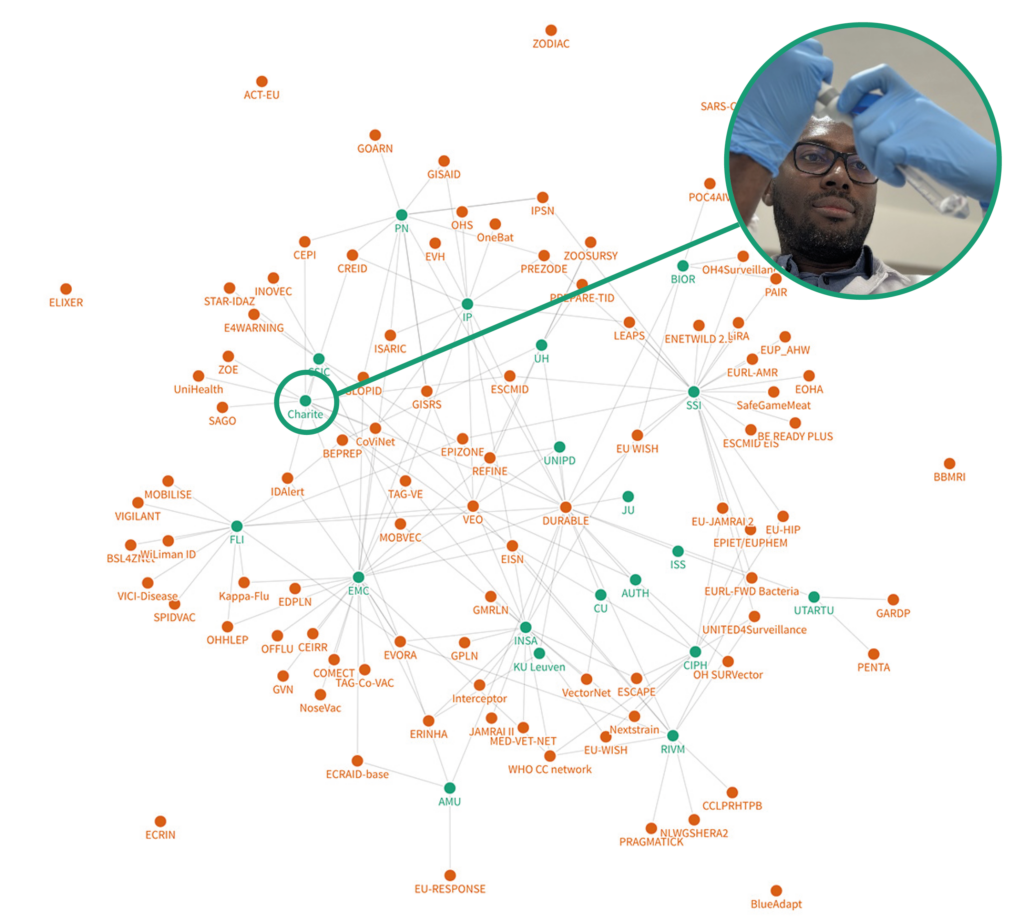
Dr. Philip El-Duah
Can you share a little about yourself and your research?
I am a junior research group leader at the Institute of Virology of the Charité – Universitätsmedizin Berlin, working on infectious diseases and zoonotic pathogens, with a strong focus on laboratory-based diagnostics and serological surveillance. My research centers on understanding how viruses like Rabies and Marburg circulate within and between animal and human populations. In particular, I work on developing and validating serological assays to improve the detection of emerging and re-emerging viral threats.
Hoe does your research fit into the bigger picture of Durable?
My work directly contributes to DURABLE’s goal of improving preparedness for emerging infectious diseases by strengthening diagnostic tools and surveillance strategies. By developing and refining assays for zoonotic viruses, my research helps generate reliable data on pathogen circulation and population-level exposure. This supports evidence-based decisions in public health and outbreak readiness.
What motivates you to be part of Durable?
I am motivated to be part of DURABLE because it brings together scientists from diverse disciplines, institutions, and regions to address a shared global challenge. DURABLE represents an opportunity to collaborate with experts beyond my own field and to contribute to a truly international effort focused on long-term preparedness rather than short-term response alone.
In addition, the network offers a valuable platform for knowledge exchange, mentorship, and capacity building, particularly for researchers working in regions heavily affected by infectious diseases. Being part of DURABLE allows me to both contribute to and benefit from this collective learning environment.
What do you expect to accomplish in the upcoming years within your own institute and by being connected to Durable?
At my institute, I aim to strengthen laboratory capacity for virus detection and serological monitoring, and to expand research on zoonotic pathogens relevant to the region. I also hope to contribute to training and mentoring students and early-career researchers, helping build the next generation of scientists focused on outbreak prevention.
Through DURABLE, I expect to contribute to international research outputs, establish lasting collaborations, and participate in projects that generate practical tools for outbreak preparedness.
What do you expect from Durable in the upcoming near future?
From DURABLE, I expect exposure to new methodologies, training opportunities, and collaboration across disciplines and countries. The network provides access to expertise, infrastructure, and ideas that would not be available within a single institution.
Most importantly, DURABLE offers a sense of purpose and community. It connects my work to a larger mission: reducing the risk and impact of future pandemics. Being part of DURABLE strengthens both my scientific skills and my confidence that my work contributes to something meaningful at a global scale.